

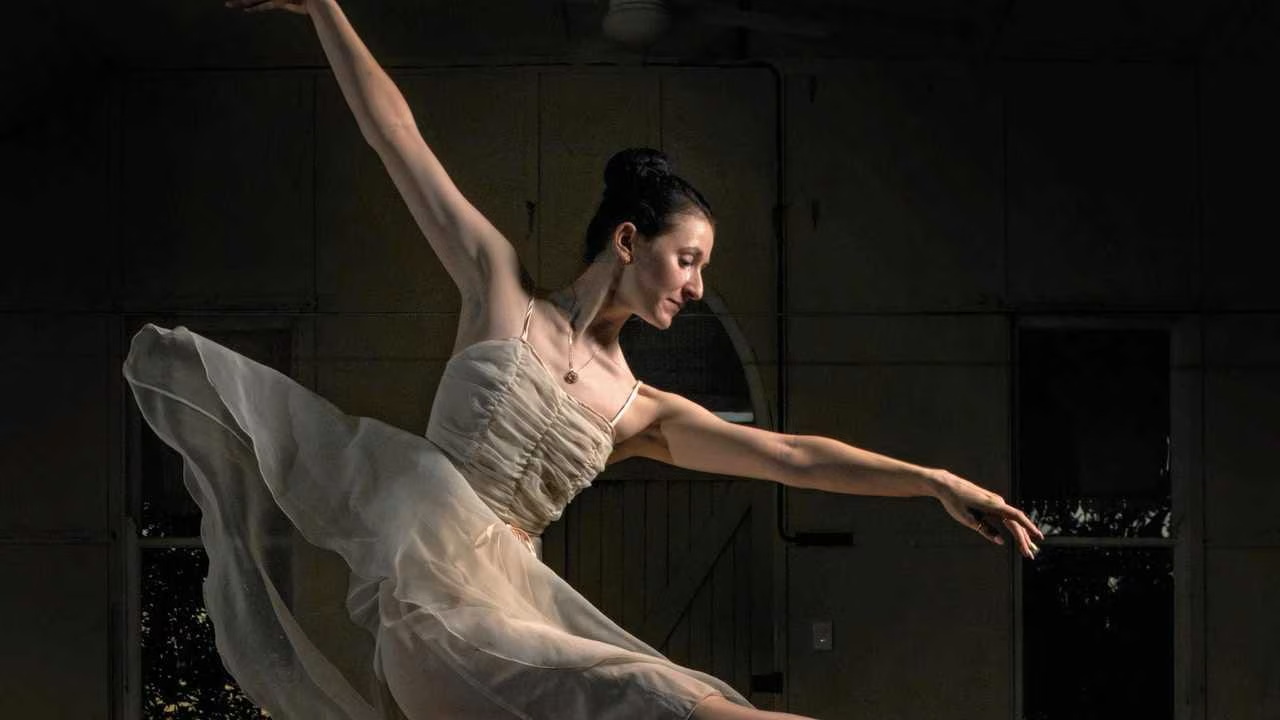
The ballerina in the perfect storm: why 2026 demands more than just “serving food”
If I had the task of translating the complexity of the contract catering sector into a single image, it would inevitably be a ballerina walking a tightrope. In her hands, she balances a long, heavy pole: on one end rests the weight of B2B (the contracting company, with its cost demands and performance metrics); on the other end vibrates the expectation of B2C (the end consumer, the employee seeking flavor and comfort).
I see this duality as the greatest richness of our segment. It is poetry in the form of service, where rigid technique must converse with the lightness of delivery. Yet anyone observing today’s landscape knows: the tightrope has changed. The wind blows harder, and the safety net has disappeared.
The perfect storm of 2026
The year 2026 did not knock on our door with subtlety. It arrived as the “perfect storm,” where political, economic, technological, and human forces converge in an unprecedented way. We are not merely witnessing a technological evolution worthy of Isaac Asimov’s pages, where automation and data promise miracles. We are living a human paradox.
On one side, we have HR and corporate management. They no longer want just “food” or a functional cafeteria. The conversation has shifted: they demand performance, full compliance, productivity, and ESG metrics that are auditable, not just “greenwashing.” On the other side, we have the employee. This is the same person who, outside the company, consumes personalized digital experiences and frequents restaurants that tell stories. They do not want to eat merely to keep working; they long for the experience, the pause, the moment to decompress.
Balancing the cold numbers required by the contract with the human warmth demanded by the user is our greatest challenge. And the only tool capable of stabilizing this ballerina in the middle of chaos is Innovation.
Innovation: oxygen, not a department
To make it through this storm, innovation must stop being a pretty word repeated in brainstorming meetings or an isolated department at the end of the hallway. Innovation, in our market, has become oxygen. If you stop innovating, you stop breathing.
At LemosPassos, we feel this viscerally: innovation does not emerge behind closed doors, as the solitary idea of a creative “genius.” It is transversal. It must be embedded in the company’s strategy and present in the daily work of every area: from the nutritionist who designs the menu to the buyer negotiating with local suppliers.
But caution: without balance, innovation can become a problem. It faces a cruel dichotomy: “If we don’t innovate, we won’t move forward; if we change too much, they may not like it.” It is always better to invest money in what your customers truly want than to spend fortunes trying to convince them to like what you created.
Know the box to think outside it
We often hear the cliché “think outside the box.” But in contract catering, thinking outside the box without deeply knowing the box is madness. The “box” is sanitary restrictions, complex logistics, tight per capita costs, and food safety. Only those who master these rules (the box) have the authority to break them or expand them safely.
The key is to stack market and consumer trends on top of that solid foundation. It is to live the company’s strategy and, in this environment of convergences, propose services that will feed the future. It is to understand that using Artificial Intelligence to forecast demand is not just technology. It is respect for the client’s budget. It is to recognize that food upcycling and full utilization of vegetables is not only sustainability. It is a response to a consumer who no longer tolerates moral and financial waste.
Done beats perfect: the culture of testing
In this volatile scenario, hope is not a strategy. We cannot sit and wait for the storm to pass. We must remember that the user of our restaurant is the same individual immersed in new technologies, someone who orders delivery through an app and rates services in real time. We must bring that agility into redesigning our operations.
The method is clear: test fast to learn faster. Every new idea, whether a new buffet layout, an autonomous payment system, or a plant based menu, must be tested and evaluated at a small scale. Often, we do this playfully, building a Minimum Viable Product (MVP) inside a pilot unit.
In real innovation, there is no “100%.” The pursuit of perfection is paralyzing and does not fit in the 21st century. Accept mistakes, they are part of discovery, but correct them quickly.
The restaurant as a connection hub
Finally, where does the heart fit into this technical engine? We can rely on terabytes of data, but food, at its core, is still feeling. Serving and delighting is our ultimate goal.
I often say, and I repeat it whenever I can: food is the biggest social network in the world. Long before Facebook, LinkedIn, or Instagram, human connections were already mediated and sealed through the act of eating.
That is our starting point. We must build corporate restaurants that are not an end in themselves, just a place to consume calories, but true hubs of connection. Spaces designed to promote conscious consumption, generate new business, foster healthy habits, and create ways to interact.
The company restaurant needs to be where company culture happens. If we can transform the cafeteria into a place where people want to be, not where they have to be, we will have won the game.
May 2026 give us the courage to be the ballerina. May we not only keep our balance on the tightrope of economics and management, but also enchant the audience, turning the storm into the stage for our best performance.
After all, you either set the trend, or you become a statistic.
Carlos Santana Silva, Projects and Innovation Manager at LemosPassos.


