

Often, training sessions are seen as a mandatory — and sometimes tedious — break. I have personally experienced, on several occasions, employees falling asleep during my training sessions, a harsh reality.
However, for those working on the front line, quality and food care need to be tangible. It is not enough to say, “wash your hands every time you switch tasks”; it is necessary to show why that forgotten corner of the nail is the perfect hiding place for pathogens that can cause a possible outbreak.
When we apply dynamics that respect the operational reality, we transform legislation into culture. Training through playful methods is not playing at work; it is ensuring that the science of food safety is accessible and indispensable to those who, in fact, protect the customer’s life every day during food preparation.
Problem-Based Learning (PBL): Adults learn better when they face real challenges. Instead of a lecture on cross-contamination, why not take the team to the storage area and ask them to identify “what is wrong with this scene”? When dealing with a cardboard box in an improper place or an uncalibrated thermometer, the employee exercises critical thinking. Food safety stops being an imposed rule and becomes a problem-solving process.
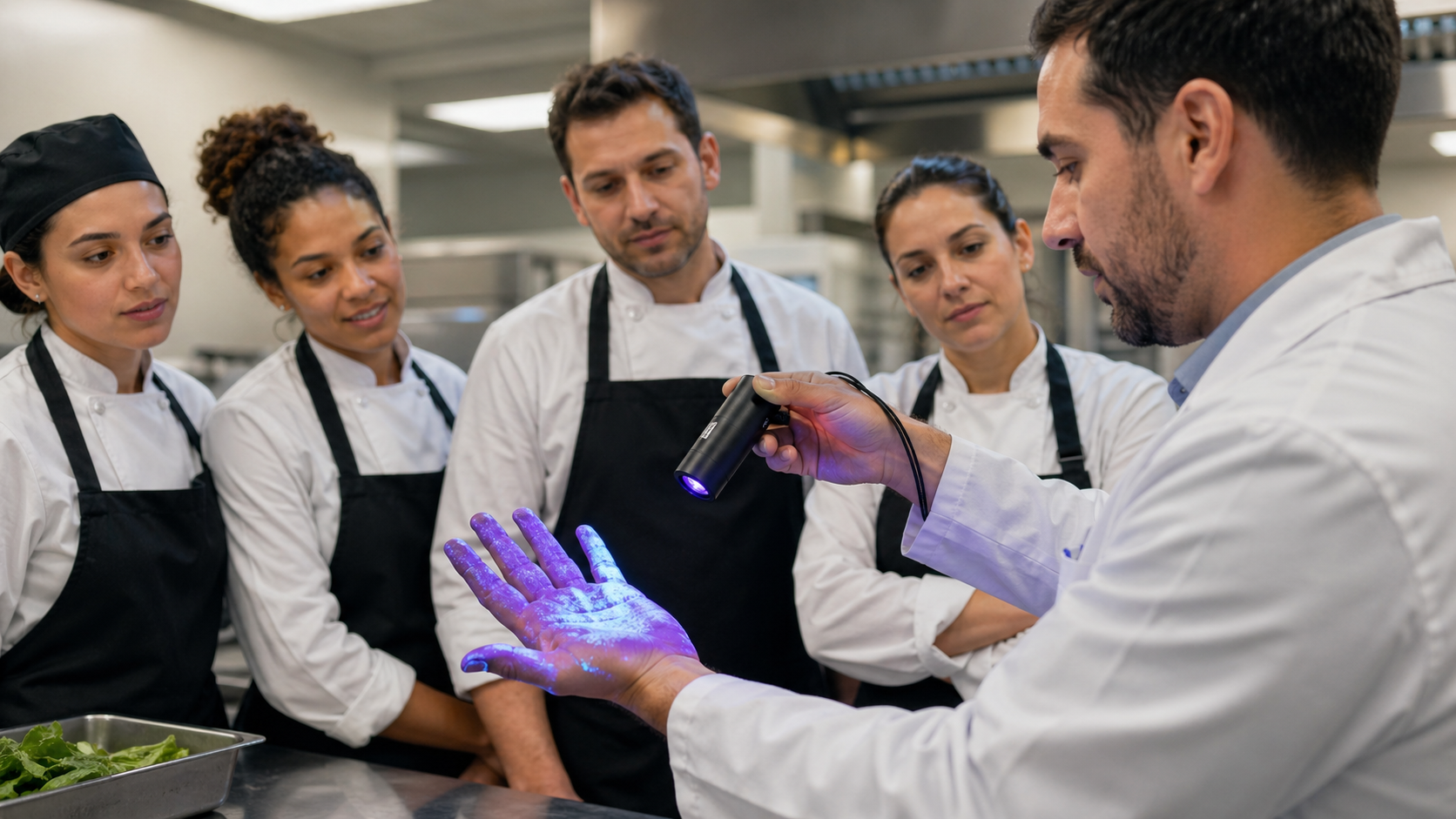
Translating the “Why” Behind Procedures: Why can’t perfume be used? Why must the beard be shaved? Why is the dishcloth a villain? In my experience, adherence increases drastically when “you can’t” is replaced by an explanation of the risk. Using dynamics such as fluorescent powder, which simulates germs under UV light, reveals the invisible. When the employee sees where the “dirt” remained after poor handwashing, their awareness tends to change.
Targeted Training and Moment Management: Training does not happen only in the training room. It happens when a manager corrects a cutting technique or reinforces the importance of the expiration label at the exact moment of handling. This is real-time education; day-to-day monitoring must be educational, not punitive.
Gamification and Engagement: Bringing in playful elements, such as hygiene competitions or “Quality Highlight” boards, stimulates a sense of belonging. When employees understand that they are the guardians of the customer’s health, they naturally take responsibility. Below, I share some playful strategies, tested and approved, through which we can increase employee engagement regarding Good Practices.
The “Theater of the Absurd”
Instead of simply pointing out mistakes, ask two employees to act out an everyday situation in the kitchen, but with one detail: they must intentionally make as many Good Manufacturing Practices (GMP) mistakes as possible in two minutes. The Dynamic: The rest of the team acts as “auditors” in a competition to see who can identify the most technical failures. The Gain: This stimulates critical thinking and observation skills in a lighthearted way, turning correction into a fun challenge. Laughter is guaranteed during the activity, and I am certain no one on the team will fall asleep.
Glitter Dynamic: The Invisible “Bacteria”
Since food safety deals with what we cannot see, making the invisible “real” is essential.
The Dynamic: At the beginning of a meeting, shake an employee’s hand while using a little fine glitter hidden in your palm. Throughout the conversation, the glitter will spread to cups, papers, and other people.
The Persuasion: At the end, show how the “bacteria” (glitter) traveled throughout the entire group through a single contact. It is the perfect visual argument to explain why hand hygiene and cross-contamination are real risks and the most dangerous of all.
Quality “Escape Game”
Transform the storage area or kitchen, during a less busy time, into a puzzle room.
The Dynamic: Hide “clues” that are, in fact, nonconformities: an unlabeled product, a cardboard box stored directly on the floor, an expired ingredient, etc. The team only “wins” the game and receives a prize or recognition if they find and correct all the problems within a set time.
The Gain: The employee stops being a passive executor and becomes the guardian of food safety, solving problems in real time.
Moment Management: “Positive Feedback in Public”
Persuasion in the best sense happens when correct behavior is celebrated.
The Practice: When monitoring the operation and seeing an employee sanitizing the countertop correctly without being asked, praise them in front of the team or use a “Quality Highlights” board.
The Persuasion: This creates a desire for belonging and recognition, making technical rigor become a fluid habit for everyone, not out of fear of punishment, but out of pride in a job well done.
As specialists, our role in Quality Management is to be the link between legislation and practice. Training is, above all, communication; it is transforming technical rigor into a fluid habit. Food safety is not built only with spreadsheets, records, and Manuals, but with people who are aware that every detail of their daily routine has the power to protect customers’ lives.
If we want different results in the compliance of our establishments, we need approaches that respect the understanding and routine of those who make the operation happen. We need to make science accessible and understandable.
– Fabiana Borrego, Entrepreneur in the Food Service sector, with a degree in nutrition and gastronomy. Co-founder of ChefNutri, a company that operates in Quality Management for Food Service, registered with Sebrae and approved by the Health Surveillance Authority of Florianópolis,
and of Geluk Academy, a company focused on curating events and missions for the Food and Beverage segment. Specialist in quality management, HACCP | APPC internal auditor, leadership, and people management.


